
English- Reading & Writing
Please see our Phonics page for information on this programme we use in Early Years.
Reading
At Stanstead, we celebrate reading throughout every phase of a child’s development. Our children’s reading journey begins in the Early Years, where children are exposed to daily phonic instruction and oral story telling. This is further enhanced through Launchpad reading lessons. This is further built on in Year One, where the children enjoy texts as a class and further enhance their understanding of texts. This then grows into appreciating texts at greater depth and analysing them in greater detail, using Complete Comprehension as a vehicle to deliver our reading lessons from (Spring) Year 2 to 6.
It is important to us at Stanstead that our curriculum is vocabulary rich, so teachers read carefully chosen texts to the children every day. The children are exposed to a wide range of stories, poetry and information books. They learn many more exciting words this way and it also inspires their writing.
Reading for Pleasure
At our school, we foster a love of reading by creating a vibrant reading culture where books are celebrated every day. Each class visits the school library every week to explore new books and choose a reading for pleasure book to take home. Children enjoy regular story time and have access to inviting reading spaces where books are organised by topic and genre, helping them to easily find stories and information that match their interests. We encourage pupils to choose books that excite them, talk about what they read, and share recommendations with their peers. Families can support reading for pleasure at home by setting aside time to read together, discussing favourite stories, and helping children explore books that reflect their passions. Together, we can nurture confident, enthusiastic lifelong readers.
How do we teach reading in Nursery?
In Nursery, we enjoy listening to stories, learn lots of new language through stories and play. Through their phonics lessons, our Nursery children develop the pre-phonic skills that will give them a solid foundation for learning to read and spell. This includes the skills of Sound Discrimination; Body Percussion; Alliteration; Rhyme and Rhythm; Voice Sounds and Oral Segmenting and Blending. We begin
with the Learning Lady super sounds which focuses on developing pre-phonic skills through a step-by- step carefully crafted sequence of learning.
Starting in Spring Term, the children also have a Code of the Week. This is taught through the use of Phonics and Talk Time resources, which feeds into the No Nonsense Phonics Skills SSP the children start with in Reception.
How do we teach reading in Reception and Key Stage 1?
We start our phonics lessons right from the beginning of our children’s Reception journey. We teach phonics using No Nonsense Phonics Skills (NNPS) resources to ensure consistency and a high-level of challenge in our children’s phonics journey. The children progress from mastering simple to more complex alphabetic code, which the children apply at both word and text level. The children also practise reading (and spelling) common exception words, such as ‘the,’ ‘said,’ ‘once’ and ‘where’.
The NNPS programme itself contains matched decodable texts which the children use for both reading and spelling practise, but we also send home Big Cat Phonics decodable books to consolidate the phonics that has been previously taught. The children practise their independent reading with these fully decodable books that match the phonics and the common exception words they have already been taught. They are empowered to apply the skills they have been taught to read their decodable book with confidence and fluency.
Early Years and KS1 (Autumn term in Year 2) follow Launchpad Reading which builds a bridge between phonics lessons and the drive to enable all children to become successful readers. Launchpad Reading is a daily reading approach that gives children the opportunity to apply their phonics knowledge and quickly develop the skills, knowledge and understanding needed to become a successful reader.
How do we teach reading from Year 2 to Year 6?
From (Spring) Year 2 to Year 6 the children learn to appreciate texts at a greater depth and analyse them in greater detail, using Complete Comprehension as a vehicle to deliver our reading lessons. This scheme has been adapted to suit the needs of the school and our lesson design approach, with a huge focus on vocabulary and the children being active readers. We have also adapted the programme to support children in reading fluently.
Children are exposed to high quality, age-appropriate texts throughout reading lessons. Our texts are also chosen based on the richness of learning they bring to our specific reading skills. We aim to cover a wide variety of authors, genres and topics to broaden our children’s horizons and widen their children’s cultural capital. In lesson one, children explore the vocabulary in the text, breaking down any issues in terms of understanding. In lesson two, the children discuss the text as a whole, making sense of it so that they can access lesson 3 and 4, where the children learn a specific reading skill, linked to comprehension. These skills are constantly revisited throughout the year. They are: word meaning, retrieval, summarising, inference, prediction, relationships (in terms of structure and characters), word choice, author intent and comparison.
How do I know the teaching will be effective?
All staff have been trained to teach reading in the way we do it at Stanstead and we work closely with the Flying High Partnership to ensure our phonics and reading teaching practices are up to date. We believe that it is very important that all teachers and teaching assistants work in the same way. The English Lead and Senior Leadership Team observe and support other teachers teaching phonics and Reading sessions to ensure that teaching is effective.
How can parents help?
From Reception, children will bring two books home from school. One will be a decodable book, based on the phonics codes they have been taught and the other a Reading for Pleasure book, which is for children and parents to share and enjoy together at home. As children move through school and complete their phonics programme of study, they will then bring home a Book Banded book and a Reading for Pleasure book as they will no longer require a phonically decodable text.
One of the best ways you can support your child is to read these books with them at least three times a week to help them improve their fluency and pace. Please trust your child’s teacher to choose the book(s) that will help your child the most.
When listening to your child read their decodable book, help your child to sound out the codes in words and then to blend the sounds together to make a whole word. Then ask them to re read the sentence you have just read together. This helps them to read with fluency. (Please see below for a ‘How to Read with your Child at Home’ information sheet)
We know parents and carers are very busy people. But if you can find time to read to your child as much as possible, it helps them to learn about books and stories. They also learn new words and what they mean. Show that you are interested in reading yourself and talk about reading as a family.
Parents Reading Meeting
Please click on here to watch a video recording of the parents reading meeting. This covers, how we teach reading at Stanstead, how we develop a love of reading and how you can support your child at home.
Writing at Stanstead
At Stanstead, we believe that all pupils are writers. Our approach to writing ensures that children develop confidence, stamina and pride in their work, underpinned by a strong foundation in spoken language, transcription skills and high-quality texts.
The Importance of Oracy
Oracy is at the heart of our writing curriculum. Before pupils write, they are given frequent opportunities to orally compose and rehearse sentences using ambitious, subject-specific vocabulary. This ensures that children can say a sentence before they attempt to write it, supporting both confidence and accuracy. Oral rehearsal also allows pupils to explore ideas, structure sentences and internalise new vocabulary.
Our approach is supported through strategies such as dictated sentences, where pupils rehearse and repeat sentences aloud, helping them to organise their thoughts and develop fluency in both speaking and writing.
Transcription: Handwriting and Spelling
Transcription skills are a key focus across our curriculum. These include handwriting and spelling, which are embedded in all writing lessons and also taught explicitly through dedicated sessions.
We use structured approaches to support transcriptional fluency, including our dictation sequence. This carefully scaffolds pupils from early letter formation through to independent sentence writing, ensuring all learners make progress regardless of starting points. Pupils practise spelling, accurate letter formation and sentence construction in a purposeful and meaningful way.
Our Writing Sequence
At Stanstead, writing is taught through a clear, consistent and progressive sequence that builds from Early Years through to Key Stage 2. This approach is underpinned by high-quality texts that inspire and engage pupils, while ensuring progression in knowledge, skills and independence over time.
In the Early Years (EYFS), the focus is on building strong foundations for writing before increasing writing demands, recognising that strong foundations are essential for successful writing. Children develop the physical skills needed for writing through a focus on gross and fine motor development. A significant emphasis is placed on oracy, with children encouraged to orally compose and rehearse sentences using rich and varied vocabulary across all areas of learning. Alongside this, pupils develop essential word-level skills, including encoding through phonics, early transcription, letter formation and emergent writing. This ensures children are fully prepared to begin recording their ideas with increasing confidence.
Opportunities for independent writing are woven throughout continuous provision, ensuring that writing is purposeful, meaningful and developmentally appropriate.
In Key Stage 1, these foundations are developed through the use of structured dictation, supporting pupils in applying their skills at a sentence level. Oracy remains central, with pupils continuing to rehearse sentences orally before writing. Teaching prioritises the development of transcriptional fluency, ensuring that spelling, punctuation and handwriting are secure before pupils move on to longer, extended pieces of writing.
In Key Stage 2, once transcriptional fluency is embedded, pupils are supported to become more sophisticated writers. Teaching focuses on authorial intent, text types and purpose, enabling pupils to adapt their writing for different audiences and contexts. Pupils apply their learning with increasing independence, drawing on the full writing sequence to plan, compose, refine and publish their work.
By Key Stage 2, each unit of writing follows this sequence:
- Immersion – pupils explore and respond to a rich text, developing understanding and acquiring ambitious vocabulary.
- Spelling – explicit teaching of spelling patterns and key vocabulary.
- Skills – focused teaching of punctuation and grammar needed for the final outcome.
- Planning – pupils organise, structure and orally rehearse their ideas.
- Star Writer Task – pupils produce their final piece of writing, demonstrating their learning.
- Editing and Publishing – pupils reflect on, refine and present their work, developing pride and ownership.
This carefully sequenced and progressive approach ensures that all pupils build the knowledge, skills and confidence to write effectively and independently as they move through the school.
Ready to Write
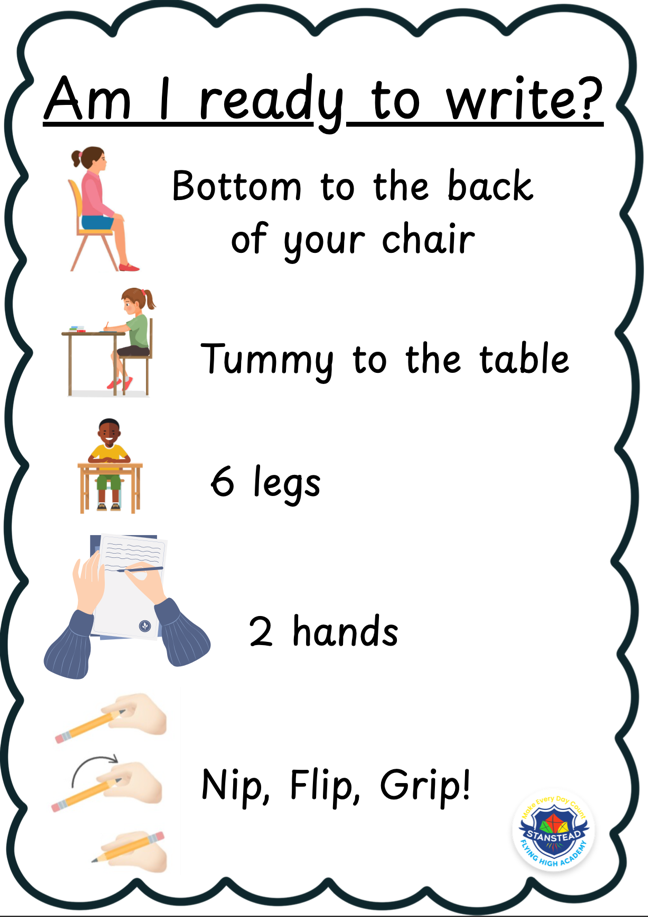
Across the school, we use our Ready to Write routine to ensure pupils are physically and mentally prepared to write. This includes expectations around posture, pencil grip and focus, for example:
- Bottom to the back of the chair
- Tummy to the table
- Six legs on the floor (chair and child)
- Two hands ready
- Nip, flip, grip!